
The problem
Lenders often treat an early missed payment as a stand-in for later default. That stand-in can fail when the economy changes the meaning of the early signal.
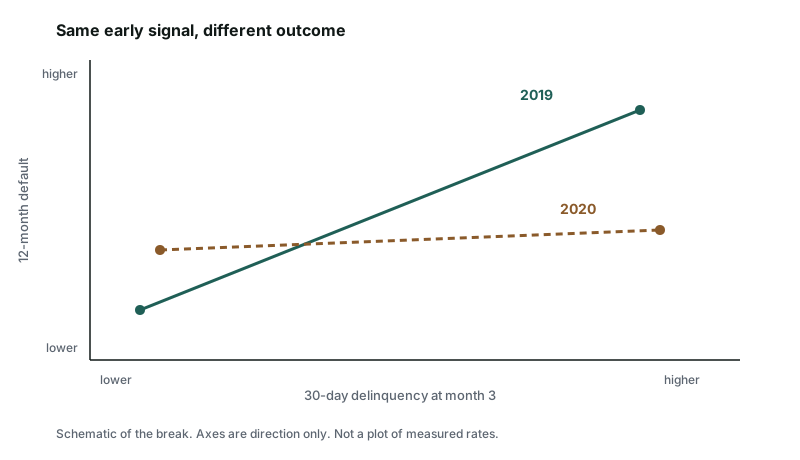
The research question
Can a model’s calibration error be estimated from early signals before loan outcomes mature, and does that estimate hold across economic regime shifts?
Ranking and calibration are separate. Ranking asks which borrower is riskier than another. Calibration asks whether a stated chance is actually that chance. A model can order borrowers well and still be wrong about the probability it prints. Default is known only after a loan has had time to fail, often a year or more. Until that outcome arrives, a wrong probability can look acceptable, because nothing has yet contradicted it. The error can sit undetected for years.
The method
One signal marks when lending conditions have left the period a model was trained on. A second step learns how early missed payments usually relate to later default, and trusts that relation less when it stops holding. The stated probability is then adjusted only while the early signal still means what it used to.
Plain description only. A provisional patent is pending. The working detail stays unpublished until a non-provisional is filed.
The market
13%
Only 13% of community institutions feel very prepared to adapt credit models to changing conditions.
Zest AI lending survey, citing Cornerstone Advisors.
SR 26-2
SR 26-2, issued April 2026, rewrote model-risk guidance for the first time since 2011.
Federal Reserve, with the OCC and FDIC. Supersedes SR 11-7 (April 2011). Most relevant to banking organizations over $30 billion in assets.
$305,000
Phase I SBIR up to $305,000.
Program ceiling. Not an award received. NSF SBIR Project Pitch is in progress.
Status
Provisional patent filed October 9, 2026. NSF SBIR Project Pitch in progress. Public Fannie Mae and Freddie Mac performance data as the validation source.
Research description. Not a lending product. Not investment advice. No model is offered for use.